ABM Execution: How Sales Teams Win with Account-Based Strategies
Account-level strategies for winning high-value deals through multi-stakeholder mapping and orchestrated outreach.
Account-Based Marketing (ABM) has been the darling of the B2B marketing world for several years, yet many organizations still struggle to bridge the gap between "Account-Based Marketing" and "Account-Based Sales Execution." In too many companies, ABM is seen as a marketing initiative where sales is a passive consumer of leads. However, the most successful revenue engines understand that ABM is a full-funnel team sport, requiring Sales to take a proactive role in the strategic capture of high-value accounts.
The goal of modern ABM isn't just to send more targeted ads; it's to provide the sales team with a deeper level of account-level intelligence that allows them to sell with higher precision. This article explores the frameworks for moving ABM from a marketing-centric project to a sales-led execution model, focusing on how CRM data and multi-stakeholder mapping drive wins in the enterprise space.
The Shift from Leads to Targeted Accounts
Traditional demand generation focuses on the volume of individual leads. ABM flips this on its head, focusing on a curated list of high-value accounts. For most sales teams, this transition is psychologically difficult. It requires moving from a "Quantity-First" mindset to a "Precision-First" mindset. Instead of hoping for 100 inbound leads, a sales rep might be tasked with winning just 5 specific target accounts over the course of the quarter. This is "Narrow-and-Deep" selling, and it requires a high degree of organizational patience.
The shift also demands a new kind of research discipline. Before a rep ever sends a first email to a target account, they should have a working knowledge of that company's strategic priorities, recent earnings calls, key executive hires, and competitive pressures. This level of preparation is what separates an ABM practitioner from a traditional outbound rep. The goal is to walk into every conversation already knowing the customer's world better than they expect you to.
The Core Components of Sales-Led ABM:
- Account Selection Alignment: Both Sales and Marketing must agree on the definition of an Ideal Customer Profile (ICP) before a single dollar is spent.
- Insight-Driven Personalization: Moving beyond "Dear [FirstName]" to outreach that references specific company initiatives, financial reports, or executive shifts.
- Orchestrated Outreach: Ensuring that marketing air cover (ads, events) is synchronized with the sales rep's outreach (calls, LinkedIn touches).
- Stakeholder Consensus Building: Intentionally mapping and engaging with the entire buying committee, not just the champion.
Multi-Stakeholder Mapping: The Enterprise Reality
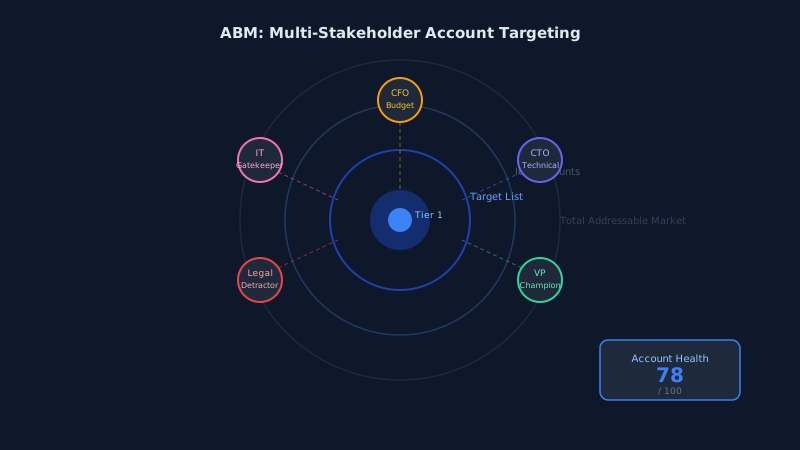
In the mid-2020s, the average enterprise purchase involves 12–15 stakeholders. An ABM approach recognizes that you aren't selling to a "Contact"; you are selling to a "Buying Committee." This reality must be reflected in the CRM architecture. If your CRM only shows one primary contact for a million-dollar deal, your ABM strategy is already failing.
Effective stakeholder mapping requires categorizing each contact by their role in the decision: Champion, Economic Buyer, Technical Gatekeeper, End User, and Detractor. Each persona has different fears, different success metrics, and different communication preferences. A message that resonates with the CFO ("This reduces operational cost by 18%") will fall flat with the IT Director ("This integrates with your existing SSO infrastructure without a custom connector"). ABM demands persona-specific messaging at every stage of the funnel.
1. The Power of the Account Health Score
Instead of just tracking individual contact engagement, ABM-enabled CRMs should track "Account Health." We measure the breadth of our engagement: Have we spoken to Finance? Has IT opened our security documentation? Does the CEO know our name? A high health score indicates we have consensus across the committee; a low score indicates a "Single-Point-of-Failure" risk. AI can automate the calculation of these scores based on activity diversity across personas.
Account Health Scores should be reviewed weekly in the pipeline meeting. When a score drops — for example, because the IT Gatekeeper hasn't responded in two weeks — it should trigger a specific action plan. Perhaps Marketing runs a targeted ad campaign toward that persona, or the AE requests a warm introduction through a mutual connection. The score is not just a metric; it is a call to action.
2. Identifying the Internal "Detractors" Early
Sales-led ABM requires identifying the potential blockers before they become a problem. Marketing can help by identifying personas that are traditionally resistant to your solution and building "Education-First" campaigns specifically for them. Sales can then follow up with "Consensus-Building" conversations that address their specific fears — security, implementation risk, or budget reallocation. By the time the deal reaches the board, the detractors should have been neutralized or converted into neutral observers.
One effective tactic is the "Detractor Briefing" — a dedicated call with the skeptic where the AE explicitly acknowledges their concerns and provides a tailored response. This signals respect and professionalism, and often converts the most vocal critic into a quiet supporter. Ignoring a detractor is the fastest way to lose a deal that was otherwise won.
3. Content as a Strategic Asset for Sales Execution
In ABM, content isn't just something used for lead capture; it's a tool for deal progression. High-performing ABM teams provide their reps with "Account-Specific" content — like a custom ROI analysis for Company X or a case study from a direct competitor of Company Y. This level of personalization signals to the prospect that the vendor has invested deeply in understanding their business. Content becomes the fuel for the sales conversation.
The most effective ABM content is co-created between Sales and Marketing. The rep provides the account intelligence ("Their CFO is obsessed with reducing SaaS sprawl"), and Marketing produces the asset ("Here's a one-pager on how we consolidate your existing tools"). This feedback loop ensures that content is always relevant, timely, and tied to a specific deal objective rather than a generic marketing goal.
The "Always-On" ABM Feedback Loop
ABM is not a "set it and forget it" strategy. It requires a constant, real-time feedback loop between Sales and Marketing. Sales should provide feedback on the signals they are getting from the field: "The IT Director at Acme seems disinterested in the security features we're highlighting — can we shift the marketing air cover for that account to focus on scalability and cost-savings?" This level of agility is what separates the winners from the losers in enterprise tech. The CRM acts as the primary feedback channel.
Weekly "Account War Room" sessions — short, focused meetings between the AE, the Marketing partner, and the SDR — are the operational heartbeat of a mature ABM program. Each session reviews the Account Health Score, identifies the next best action for each stakeholder, and aligns the marketing calendar with the sales motion. These sessions should be no longer than 30 minutes and should result in a clear, documented action plan in the CRM.
Measuring Success: Beyond the MQL
Traditional metrics like Marketing Qualified Leads (MQLs) are irrelevant in an ABM world. Instead, organizations should measure "Account Penetration," "Stakeholder Coverage," and "Pipeline Velocity within Target Accounts." When Sales and Marketing are unified around these shared, account-level KPIs, the organizational friction disappears, and everyone focuses on the same goal: winning the accounts that move the needle.
Additional ABM-specific metrics worth tracking include: the number of unique personas engaged per account, the average time from first touch to first meeting, and the "Influence Rate" — the percentage of closed-won deals that had active ABM air cover running during the sales cycle. These metrics tell a richer story than MQL volume and provide a much clearer picture of the program's true ROI.
Building an ABM Pilot Program
For organizations new to the strategy, a pilot program is essential. Start with a small group of reps and a highly curated list of 20 target accounts. This focus allows the team to refine the orchestration between Sales and Marketing before scaling the program to the entire organization. Success in the pilot becomes the internal proof point for the wider ABM transition. It also allows for the identification of "ABM Champions" who can mentor others during the rollout.
The pilot should run for a minimum of one full quarter. ABM is a long-game strategy, and expecting results in the first 30 days will lead to premature abandonment. Set clear success criteria upfront — for example, "We will consider the pilot successful if we achieve first meetings with 60% of our target accounts and move 30% into active pipeline within 90 days." These benchmarks create accountability without creating unrealistic pressure.
The Role of Intent Data in Account Selection
Intent data providers allow sales teams to identify which accounts are actively researching your category right now. By knowing which accounts are in a "Buying Window," Sales can prioritize their outreach to those who are already in a discovery mindset. This data should be piped directly into the CRM, alerting reps as soon as a target account shows a spike in research activity. Speed to intent is a massive competitive advantage — the first vendor to reach an in-market buyer has a statistically higher win rate.
Intent data is most powerful when combined with your own first-party engagement data. An account that is both showing high third-party intent signals AND has recently engaged with your website's pricing page is a "Double Signal" account — the highest priority for immediate, personalized outreach. Building this combined scoring model within the CRM is one of the highest-ROI investments a RevOps team can make.
Managing the Account Handoff in ABM
In ABM, the handoff from Sales to Customer Success is even more critical, as the relationship is deeper and more complex. The CSM must be briefed not just on the product requirements, but on the entire stakeholder map and the political dynamics of the account. A failure here can undo months of account-based trust-building in a single week. The AE should remain involved in the first executive business review (EBR) to provide continuity and reinforce the relationship that was built during the sales cycle.
Conclusion: ABM is the New Sales Standard
As the market becomes more crowded and decision-making more centralized, the "Shotgun" approach to sales is increasingly obsolete. ABM is more than just a marketing tactic; it is the modern standard for B2B sales execution. By integrating account-level insights into every stage of the CRM workflow, sales teams can build stronger, more strategic partnerships that lead to higher win rates and larger deal sizes. The path to the enterprise win is narrow, deep, and account-centric.