AI in Sales Forecasting: The Future of Revenue Predictability
A deep dive into how predictive analytics and behavioral signals are transforming the physics of the sales funnel.
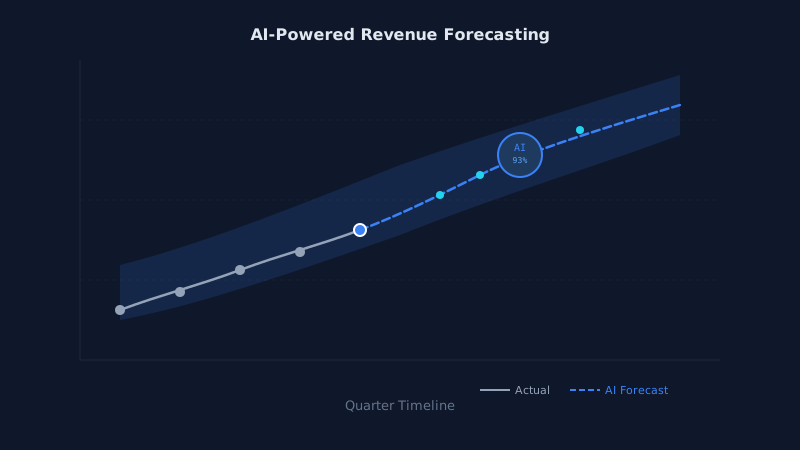
Predicting revenue has traditionally been more of an art than a science, often relying on "finger in the wind" estimates from sales reps and the gut feelings of seasoned managers. However, as we move through 2026, the integration of Artificial Intelligence into CRM systems is fundamentally changing the physics of the sales funnel, shifting the focus from subjective sentiment to objective behavioral signals.
For decades, the standard for sales forecasting was a simple weighted pipeline model. If a deal was in "Stage 3," it was assigned a 50% probability of closing. This model assumes that all deals within a stage are created equal, ignoring the massive variability in momentum, stakeholder engagement, and competitive pressure that exists in reality. In a volatile economic landscape, this lack of precision is no longer acceptable. Companies that rely on legacy forecasting models are finding themselves blindsided by end-of-quarter misses and unexpected churn.
The Failure of the Subjective Forecast
Sales professionals are naturally optimistic — it's a prerequisite for the job. You have to believe in the win to overcome the inevitable rejections. However, this optimism, while essential for pushing through barriers, is the primary enemy of an accurate forecast. We've all seen the "happy ears" phenomenon where a rep believes a deal is moving just because a prospect was polite on a call or expressed a vague interest in a "follow-up next month."
"The most dangerous number in any sales organization is a forecast built on sentiment rather than signals."
Traditional weighted forecasting is a linear solution to a non-linear problem. It assumes stability in the environment. AI solves this by looking past the "Stage" field and analyzing the actual anatomy of the deal. Instead of asking a rep "How do you feel about this deal?", modern platforms ask the data "What is this deal actually doing?" The difference between these two questions is the difference between a 60% forecast accuracy and a 92% forecast accuracy.
The Signals That Actually Matter: A Multi-Threaded Approach
Modern AI-driven CRMs look at hundreds of variables simultaneously to produce a "deal health score." While every business is different, several core signals consistently correlate with high-probability outcomes. One of the most critical is multithreaded engagement.
1. Multithreaded Engagement Analysis
Single-threaded deals — where a rep is only talking to one person — are the leading cause of "dead deals" in the enterprise space. If that one person leaves the company, loses interest, or has their budget frozen, the deal dies. AI can detect the depth and breadth of engagement by analyzing email headers, meeting invitations, and CRM contact roles. It can flag a deal as "High Risk" if the rep hasn't engaged with at least three distinct personas (e.g., the User, the IT Gatekeeper, and the Economic Buyer) by a certain stage in the cycle.
The AI doesn't just count contacts — it evaluates the quality of those interactions. A 45-minute call with the CFO where pricing was discussed carries far more weight than three brief email exchanges with a junior analyst. By weighting interactions by persona seniority and conversation depth, the model produces a much more accurate picture of true deal momentum.
2. Communication Sentiment and Velocity
It's not just about the number of emails sent; it's about the time between them and the language used within them. A sudden drop in response velocity (the "Ghosting Signal") is often a more accurate predictor of a stalled deal than a rep's "Feeling good" note. AI can also perform sentiment analysis on prospect communications. Are they asking technical questions? Are they negotiating terms? Or are they providing short, non-committal answers? AI picks up on these nuances long before a human reviewer would.
Sentiment analysis also tracks the evolution of language over time. A prospect who moves from asking "How does this work?" to "What would implementation look like for our team?" is showing a clear progression toward commitment. Conversely, a prospect who starts using phrases like "We're still evaluating our options" after previously discussing timelines is showing a regression signal. These linguistic shifts are invisible to the human eye in a busy pipeline but are immediately apparent to a trained AI model.
3. Competitive Intelligence Recognition
Natural Language Processing (NLP) allows AI to listen for mentions of competitors in transcribed sales calls. If a prospect mentions a competitor more frequently in Stage 4 than they did in Stage 2, the AI recognizes a potential competitive threat and can automatically trigger a "competitive battlecard" for the rep, while simultaneously alerting management to the shift in deal dynamics. This real-time competitive intelligence is one of the most tangible ROI drivers of AI-powered forecasting.
Deep Dive: Behavioral Scoring vs. Demographic Scoring
Most traditional lead scoring systems are static — they look at a prospect's job title, company size, and industry. AI-driven forecasting moves into the dynamic realm of behavioral scoring. It asks: "How is the prospect interacting with our brand right now?"
- Content Consumption Depth: Did they just open the PDF, or did they spend 4 minutes on the "Pricing" page?
- Referral Pathways: Did they come from an organic search, or did they follow a link shared by a known internal champion?
- Temporal Decay: Is their interest increasing as the quarter ends, or has their engagement plummeted since the last demo?
Behavioral scoring is dynamic by nature — it updates in real time as new signals arrive. A deal that scores 72 today might score 85 tomorrow if the prospect attends a webinar and downloads a case study. This real-time responsiveness allows sales managers to prioritize their coaching time on the deals that are actively moving, rather than spending equal time on every deal in the pipeline regardless of momentum.
From Retrospective to Proactive: The Strategic Shift
The true value of AI forecasting isn't just the final number it produces for the end of the quarter; it's the ability to intervene while there is still time to affect the outcome. In a traditional environment, the weekly pipeline review is a post-mortem: "Why did we lose the Acme deal?" In an AI-enabled environment, the conversation is proactive: "The Acme deal has a low health score because the Legal department hasn't opened our contract link in 72 hours — what's our plan to re-engage them?"
This shifts the sales manager's role from a "numbers checker" to a strategic coach. They can focus their limited time on the deals that are "in the margin" — those that have a high probability but need a specific nudge, or those that are technically sound but lack executive alignment. The AI handles the monitoring; the human handles the strategy.
Case Study: The "Ghosting" Signal Intervention
Consider a mid-market SaaS company that implemented AI forecasting. The AI flagged a $200k deal that had been in "Stage 4" for 45 days. The rep reported "Positive sentiment," but the AI noted that 100% of recent communication was coming from the rep, with zero replies from the prospect in 14 days. The manager, alerted by the AI, intervened and discovered the Champion had been unexpectedly hospitalized. Because they caught the signal early, the team was able to pivot to the secondary contact and save the deal. Without the AI flag, this deal would have sat in the forecast as "Likely to Close" until the end of the quarter, when it would have been a surprise loss.
The Implementation Challenge: Garbage In, Garbage Out
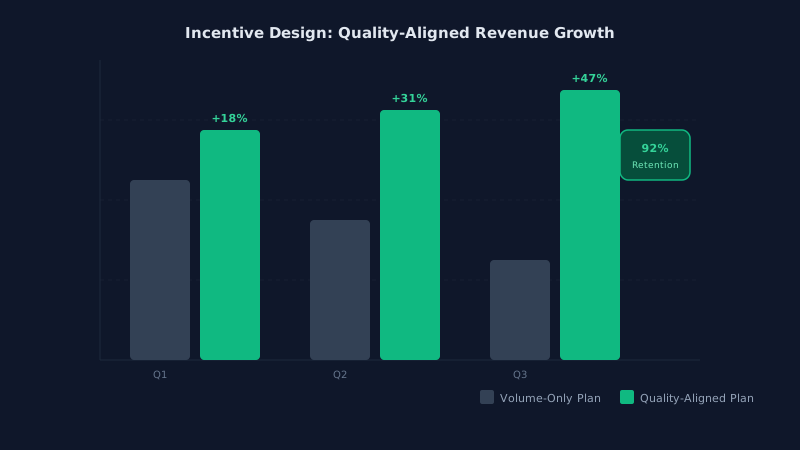
For AI to work, the data must be clean. This is the biggest hurdle for most organizations. Sales teams that thrive with AI forecasting are those that treat CRM hygiene not as an administrative burden, but as a strategic asset. The incentive structure must change: reps shouldn't just be rewarded for the win; they should be incentivized for the accuracy and completeness of the data that leads to the win.
A practical approach is to implement "Data Quality Gates" — CRM rules that prevent a deal from advancing to the next stage unless specific fields are populated. For example, a deal cannot move to "Proposal Sent" unless the Economic Buyer has been identified and logged. These gates feel restrictive at first, but they quickly become second nature and dramatically improve the quality of the data that feeds the AI model.
Checklist for AI Readiness:
- Unified Data Entry: Ensure all calls, emails, and meetings are automatically logged through integrations.
- Standardized Persona Roles: Define clear roles for every contact in a deal (Champion, Decision Maker, Technical Stakeholder).
- Automated Value Capture: Use NLP to pull deal risks and competitor mentions directly from call transcripts.
- Continuous Training: Regularly review AI-generated "Deal Health" scores with reps to build trust in the system.
The Technical Architecture of Predictive Revenue
Building a predictive engine requires more than just an AI plugin. It requires a unified data layer where your CRM, your communication tools (Email/Slack/Zoom), and your marketing automation platform all speak the same language. This "Revenue Data Platform" (RDP) is the foundation of the 2026 sales organization. Without it, your AI is just guessing based on a fraction of the truth.
Key Components of the RDP:
- Data Orchestration: The ability to move data between systems without latency or duplication.
- Identity Resolution: Ensuring that "John Doe" on LinkedIn is the same "John Doe" who just signed up for your webinar.
- Temporal Storage: Storing not just the current state of a deal, but how it has changed over time to allow for velocity analysis.
Breaking Down Silos Between Sales and Marketing
AI forecasting also bridges the perennial gap between sales and marketing. When both teams are looking at the same deal health scores and stakeholder engagement data, the finger-pointing stops. Marketing can see exactly which pieces of content are moving deals forward, and sales can provide real-time feedback on lead quality based on objective AI analysis rather than anecdotal evidence. This alignment creates a unified revenue engine that is greater than the sum of its parts.
Shared dashboards — visible to both Sales and Marketing leadership — are the practical tool for this alignment. When a Marketing leader can see that their latest whitepaper is being consumed by prospects in Stage 3 and correlates with a 15% increase in win rate, they have a clear signal to produce more content of that type. Data replaces opinion, and the conversation shifts from "We need more leads" to "We need more of this specific type of content for these specific accounts."
The Role of Generative AI in Personalization
While predictive AI handles the numbers, Generative AI is transforming how reps interact with those numbers. Imagine an AI that not only predicts a deal will close but also drafts the personalized contract summary or the "Next Steps" email based on the specific objections raised during the demo. This level of automated personalization allows reps to operate at an enterprise level of quality with the speed of a high-volume outbound team. The rep's role shifts from "content creator" to "content curator" — reviewing and personalizing AI-generated drafts rather than starting from a blank page.
Multi-Region Forecasting Challenges
For global organizations, AI must account for regional differences in sales cycles, negotiation styles, and economic conditions. A Stage 3 deal in Germany might have a different behavioral signature than a Stage 3 deal in the United States. Advanced AI models are now "Locality-Aware," adjusting their health scores based on the specific cultural and economic context of the account, providing a level of global visibility that was previously impossible. This regional calibration is essential for any organization operating across multiple geographies.
Looking Ahead: The Prescriptive Future
We are moving from "Predictive" AI (what will happen) to "Prescriptive" AI (what we should do). Future CRM systems won't just tell you that a deal is at risk; they will recommend specific actions: "Invite the CTO of Acme to our upcoming executive dinner to resolve the security concern flagged in yesterday's call." The future of revenue predictability isn't about replacing the human element of sales; it's about augmenting it with data-driven guardrails that remove the fog of war from the pipeline.
Final Thoughts
In the next 24 months, the gap between AI-enabled sales teams and traditional teams will become an abyss. The ability to forecast with 95%+ accuracy isn't just a convenience; it's a competitive requirement for any growth-oriented organization in 2026 and beyond. The organizations that invest in their data infrastructure today will be the ones writing the playbooks that everyone else follows tomorrow.