Remote Sales Team Alignment: Strategies for Virtual Pipeline Control
Building intentional communication frameworks and CRM-led accountability for distributed sales leadership.
The shift to remote and hybrid work hasn’t just changed where we open our laptops; it has fundamentally altered the physics of how sales teams stay aligned. Without the natural "osmosis" of a physical office—overhearing a tough call, seeing a colleague’s frustration, or grabbing a quick hallway debrief—sales organizations face a new "Visibility Gap" that can quickly lead to pipeline drift and morale decay.
In the traditional sales floor model, alignment was often accidental. You knew what was happening because you were there. In 2026, alignment must be intentional. Leaders who fail to realize this find themselves managing blind, relying on lagging indicators (like Closed-Won revenue) rather than leading indicators (like activity quality and stage movement). This article explores the frameworks required to lead a high-performing distributed sales team where the CRM acts as the primary source of truth.
The Death of "Office Osmosis" and the Rise of Intentionality
Ambient awareness—the ability to sense the energy and direction of a team through physical proximity—was a powerful but unmeasured asset. In a remote environment, this is replaced by silence. A rep might receive a new, difficult objection from a major competitor, but instead of sharing it with the team at lunch, they keep it to themselves. By the time the manager hears about it, three other deals have been lost to the same objection.
The Three Pillars of Remote Alignment:
- Digital Transparency: Every action, note, and next step must be documented in a way that is visible to the entire team. "Hidden" data is toxic to remote alignment.
- Asynchronous Communication: Reducing the number of live meetings in favor of high-quality CRM updates and recorded call clips.
- Structured Accountability: Shifting the focus from "hours worked" to "outcomes achieved" and "process adherence."
The CRM as the Virtual Sales Floor
In a remote world, your CRM is no longer just a database; it is your virtual sales floor. If it isn't in the CRM, it didn't happen. This requires a cultural shift where data entry isn't seen as an administrative burden, but as the primary way of "speaking" to the rest of the team.
1. Hyper-Contextual Notes and Activity Logging
Standard activity logs like "Had a good call" are useless in a remote setting. Reps must be trained to log specific details: Who were the stakeholders? What was the specific pain point? What is the 'Reason to Buy'? These notes allow managers to provide strategic input without needing to jump on a 30-minute Zoom call for every deal update.
2. Real-Time Notification Loops and Signal Injection
The "bell-ringing" culture of the office must be digitized. When a deal moves from Stage 2 to Stage 3, or when a large contract is signed, the entire team should see it in real-time through integrations with communication tools like Slack or Microsoft Teams. This isn't just about celebration; it's about maintaining a shared sense of momentum and competition.
Asynchronous Coaching: Scaling the Manager's Impact
The biggest bottleneck in remote sales is the manager's calendar. Moving from synchronous pipeline reviews (where everyone sits in a room and listens to updates) to asynchronous reviews is a game-changer. Managers should review deal health and activity logs in their own time, leaving comments and questions directly within the CRM. The weekly live meeting can then be reserved for "Deep Dive" strategy sessions on specific high-value accounts.
The Power of Call Recordings
Tools like Gong, Chorus, or built-in CRM recording features are essential for remote coaching. They allow managers to listen to the "voice of the customer" directly. Sharing a 2-minute clip of a successful objection handle with the entire team is more effective than any training manual. It creates a "closed-loop" learning environment that mimics the learning that used to happen accidentally in the office.
Managing the Global "Time Zone Tax"
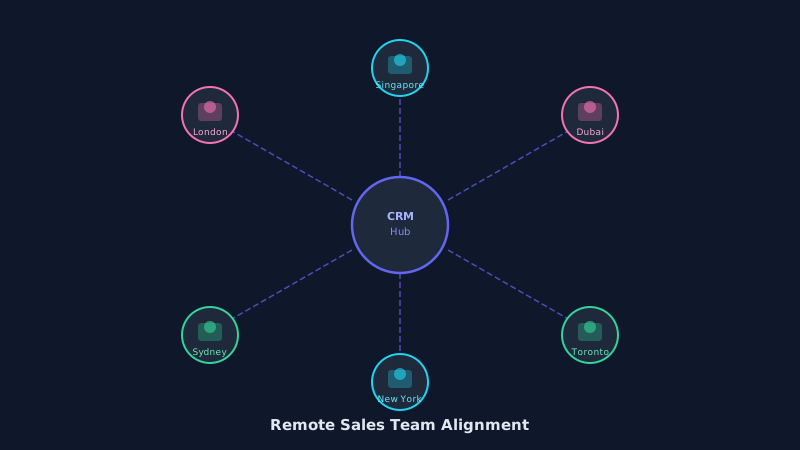
For teams spread across continents, time zones are the final barrier to alignment. The 2026 sales leader doesn't try to force everyone into a single 9 AM EST meeting. Instead, they embrace the 'Follow the Sun' sales model. When a rep in Singapore finishes their day, they leave a 'Hand-Off' note in the CRM for their colleague in London. This level of coordination requires a high degree of process maturity and a CRM that can handle multi-regional handoffs without data loss.
Maintaining the Psychological Connection
Alignment isn't just about spreadsheets and dashboards; it's about the people. Remote sales can be isolating and emotionally draining. Leaders must create spaces for non-transactional connection. Whether it's a "Virtual Coffee" or a dedicated "Wins and Woes" channel, the goal is to ensure that the team feels like a cohesive unit, even when they are thousands of miles apart.
The Role of AI in Remote Signal Detection
AI can bridge the visibility gap by identifying patterns that a human manager would miss. For example, the AI might notice that a rep's email response time has tripled over the last week, or that they are getting 'stalled' at a specific deal stage more frequently than their peers. These 'Soft Signals' allow the manager to check in before a performance issue becomes a crisis.
Conclusion: Leading with Outcomes, Not Eyesight
The future of sales leadership belongs to those who can lead teams they cannot see. By leveraging the CRM as a central nervous system and replacing "Office Osmosis" with intentional, asynchronous frameworks, leaders can build sales organizations that are actually *more* aligned and effective than the legacy office-based models.
Remote Leadership Checklist:
- Is your CRM configured to capture the 'Why' behind every deal stage move?
- Have you replaced status meetings with asynchronous dashboard reviews?
- Are your top reps' call recordings being used as primary training assets?
- Do you have a clear 'Regional Hand-Off' protocol for global accounts?
- Is there a dedicated space for non-sales related team connection?