Sales Resilience: Building a Team That Thrives in Volatile Markets
Mental and operational models for maintaining sales momentum and adapting to shifting priority in dynamic economies.
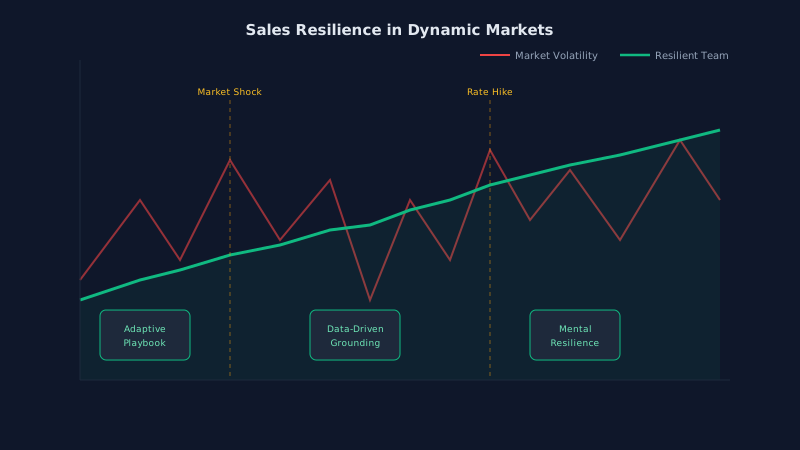
Sales has always been a profession of highs and lows, but the current economic climate—characterized by volatile markets, shifting interest rates, and rapid technological disruption—has created a new level of pressure on the modern sales organization. In this environment, "Resilience" is no longer just a soft skill or a motivational buzzword; it is a critical operational framework for building a team that can perform consistently regardless of the market wind.
Resilience in sales isn't about "toughing it out" through sheer willpower; it's about building systems, both psychological and operational, that allow a team to absorb shocks, adapt to new realities, and maintain momentum when the traditional playbooks stop working. This article explores the mental models and organizational strategies required to build a resilient sales engine that doesn't just survive volatility, but thrives within it. Resilience is the engine of stability in an unstable world.
The Psychology of the Volatile Market
In a bear market or an economic downturn, the biggest enemy of a sales team isn't the competition—it's anxiety. Anxiety leads to "Desperation Selling," where reps begin to cut corners, over-promise on features, or devalue the product to win a quick deal. This behavior might solve a short-term quota gap, but it creates a long-term disaster for the brand and the P&L. Desperation is a signal of weakness that prospects can sense instantly.
Resilience starts with "Radical Transparency" from leadership. Reps need to know the reality of the market, but they also need to know that the organization has a plan. When leadership provides a steady hand and a clear directional "North Star," the team's mental energy shifts from "Worrying about the external" to "Executing on the internal." Transparency is the antidote to the rumors and uncertainty that thrive in a vacuum.
The Core Pillars of a Resilient Sales Culture:
- Outcome-Neutral Execution: Focusing on the quality of the activity, regardless of the immediate result of a single call or email.
- Adaptive Playbooking: The ability to rewrite the sales strategy in real-time as buyer priorities shift.
- Sustained Energy Management: Recognizing that sales is a marathon of rejection and protecting the team's mental well-being.
- Data-Driven Grounding: Using CRM metrics to separate facts from feelings during turbulent times.
Adaptive Playbooking: Pivoting When the Market Shifts
In a stable market, the same value proposition can work for years. In a dynamic market, what mattered to a customer yesterday (e.g., "Growth at all costs") may be irrelevant today (e.g., "Operational efficiency and cost reduction"). A resilient organization is one that can pivot its messaging in days, not months. The playbook must be a living document, not a static PDF. It must adapt faster than the market does.
1. Tightening the Feedback Loop
Sales Ops should act as the "Early Warning System." When reps start reporting a new type of objection or a shift in buyer sentiment, that information must flow back to Marketing and Product immediately. Instead of waiting for a monthly post-mortem, resilient teams run weekly "Market Signals" sessions where the front-line reps share what they are actually hearing on discovery calls. This allows the organization to adjust its battlecards and messaging in real-time. Speed of insight is the key to resilience.
2. Focusing on "Near-Term Value" and Small Wins
During economic uncertainty, long-term ROI calculations become less compelling to a stressed CFO. Resilient teams shift their focus to "Near-Term Value"—how can we solve a problem for the customer in the next 30, 60, or 90 days? By shortening the "Time to First Value," sales reps can overcome the buyer's natural resistance to large, multi-year commitments and keep the pipeline moving through smaller, "wedge" deals. Small wins build the momentum needed to tackle the big ones.
3. The Role of "Loss Analysis" in Resilience
We learn more from our losses than our wins, but only if we have the courage to look at them honestly. Resilient organizations foster a "No-Blame" culture around loss analysis. Why did the deal actually fail? Was it budget? Was it a lack of perceived urgency? Was it a failure on our part to identify the real decision-maker? By standardizing the "Loss Reason" codes in the CRM and discussing them openly, the team builds a collective intelligence that makes them harder to beat the next time. A loss is only a failure if you don't learn from it.
Operational Resilience: Reducing the Internal Friction
When the external market is hard, you cannot afford internal friction. Every unnecessary administrative task, every slow-loading dashboard, and every broken handoff is a "Tax" on the team's resilience. Strategic Sales Ops must double down on "Friction Reduction" during volatile times. If you want a rep to be resilient in the face of a tough prospect, give them a CRM that is fast, intuitive, and actually helps them do their job. Resilience is easier when the tools are helpful, not hindering.
Mental Resilience: The Art of the Bounce-Back
High-rejection environments require a specific kind of mental training. Resilient teams embrace "Post-Call Reflection"—a 2-minute practice where a rep notes what they did well and one thing they would change, regardless of whether the prospect said 'Yes' or 'No.' This detaches the rep's self-worth from the outcome of the call and attaches it to the quality of their execution. It creates a team of "Professional Practitioners" rather than "Emotional Gamblers." The bounce-back is where the win is born.
Conclusion: Volatility as a Filter for Excellence
A dynamic market acts as a filter: it wipes out those who rely on inertia and luck, and it elevates those who have built a foundation of resilience. By focusing on intentional alignment, adaptive messaging, and a culture of radical transparency, sales leaders can build teams that are not just "unbreakable," but teams that actually grow stronger through the challenges they face. The market will always be volatile; your sales engine doesn't have to be. Excellence is the final result of resilient execution.