Sales Tech Stack Consolidation: Focus Your Team on Core Execution
The productivity gains and cognitive benefits of reducing tool complexity and focusing on a single source of truth.
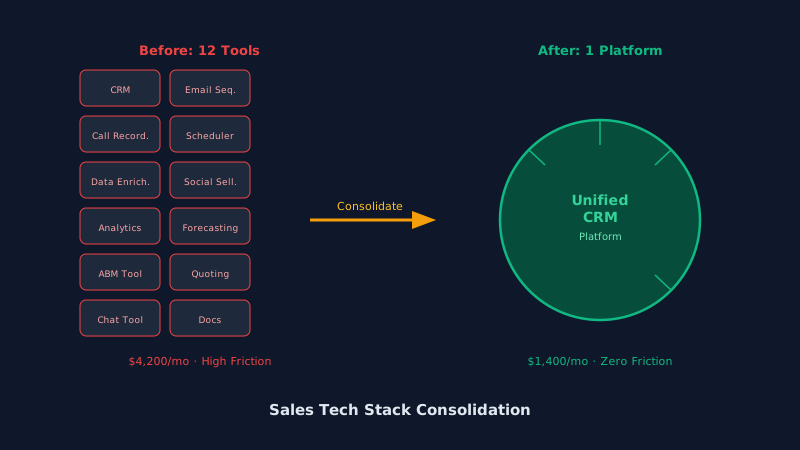
The "SaaS Explosion" of the late 2010s and early 2020s has left the modern sales organization with a bittersweet legacy: an unprecedented level of technological capability, and an equally unprecedented level of complexity. The average sales representative today is toggling between 8 and 12 different tools daily—from CRM and email sequences to data enrichment, call recording, meeting scheduling, and social selling platforms. This "Context Switching Tax" is the single greatest drag on sales productivity in 2026.
Strategic sales leaders are beginning to realize that "More Tools" does not equal "More Revenue." In fact, the opposite is often true. Tool fatigue leads to fragmented data, a lack of process compliance, and a sales force that spends more time managing their stack than managing their deals. This article explores the frameworks for Sales Tech Stack Consolidation—the art of reducing complexity to increase execution speed and revenue predictability.
The Cost of Choice and the "SaaS Tax" on Productivity
Psychologically, the human brain is not built for high-frequency context switching. Every time a rep moves from a LinkedIn tab to a CRM record, and then to a separate call-recording dashboard, there is a cognitive "Reset" that occurs. This reset might only take 30 seconds, but stretched across a team of 50 reps over an entire year, it represents thousands of hours of lost selling time. This is the "SaaS Tax." It’s an invisible line item on your P&L that is costing you millions in potential revenue.
Beyond the cognitive cost, there is the data cost. In a fragmented stack, truth is distributed. The "Notes" are in the call recorder, the "Engagement" is in the outreach tool, and the "Opportunity" is in the CRM. When an executive asks for a pipeline forecast, they aren't getting a unified view; they're getting a patchwork quilt of disparate data sources that rarely align. Consolidation isn't just about saving money on licenses; it's about reclaiming the organizational "Single Version of Truth."
The Core Principles of Stack Consolidation:
- The "CRM-Centric" Filter: If a tool doesn't bi-directionally sync with the CRM in real-time, it doesn't belong in the stack.
- Native Over Niche: Favoring integrated features within your core CRM platform over "best-of-breed" standalone tools that require complex middleware.
- The "One-Screen" Mandate: Aiming to keep the sales rep within a single browser tab (the CRM) for at least 80% of their daily workflow.
- Data Integrity First: Prioritizing tools that improve data quality over those that just add 'features.'
Auditing the "Shadow Stack": The First Step to Consolidation
Before you can consolidate, you must understand the reality of what is being used. Many organizations suffer from "Shadow Stack"—tools bought by individual reps or small teams on personal credit cards because the "Official" tools are too clunky, slow, or difficult to use. Consolidation must start with a radical, honest audit of every tool in the organization, including their actual usage rates, data integration health, and rep sentiment. This audit should be led by RevOps, not IT.
1. Usage vs. Utility Analysis
Just because a tool is "Used" doesn't mean it provides "Utility." Reps might use a specific data enrichment tool simply because it's what they've always used, even if a more modern, integrated version exists within the CRM. Revenue Operations should measure the correlation between tool usage and win rates. If a tool has high usage but no measurable impact on win rate or velocity, it’s a candidate for removal. We want 'Outcome-driving' tools, not 'Activity-driving' ones.
2. Identifying Overlapping Capabilities
As modern SaaS platforms evolve, their feature sets inevitably expand. You may be paying for a standalone meeting scheduler, while your CRM now has that feature built-in. You may be paying for a separate account-based marketing tool, while your email engagement platform has added ABM capabilities. Consolidating these overlaps is the fastest way to reduce both costs and complexity. The goal is to reach a 'Minimalist stack' that provides maximum coverage.
3. The "Rip and Replace" Risk Assessment
Consolidation is a change management project, not just a procurement one. Removing a beloved (if inefficient) tool can cause a temporary dip in morale or productivity. Every consolidation decision must be weighed against the "Transition Cost"—the training, data migration, and cultural adjustment required to move the team to a new, unified process. A successful consolidation requires 'Sales Buy-in' as much as 'Executive Approval.'
The "Platform Era": Managing the Hub, Not the Spokes
The trend with major CRM providers is toward a "Platform" approach, where they provide the hub and a marketplace of deeply integrated spokes. In 2026, the competitive advantage belongs to the sales leader who can build a "Frictionless Stack" where data flows automatically and invisibly between functions. The goal is to move from a "Hand-Cranked Revenue Machine" (where reps manual move data) to an "Automated Revenue Factory" (where technology handles the flow, allowing reps to focus on the conversation). The platform is the foundation of scalability.
Conclusion: Speed Through Simplicity
The era of buying a tool for every problem is over. The standard for the modern sales tech stack is no longer "How many features does it have?", but "How much friction does it remove?" By consolidating your stack, unifying your data, and focusing your team on a single source of truth, you aren't just saving money—you're giving your team the most valuable gift of all: the time to actually sell. In sales, simplicity isn't just a design choice; it's a productivity strategy.