The Evolution of Sales Ops: From Tactical Support to Strategic Partnership
How the role is shifting from manual data management to revenue architecture and predictive partnership.
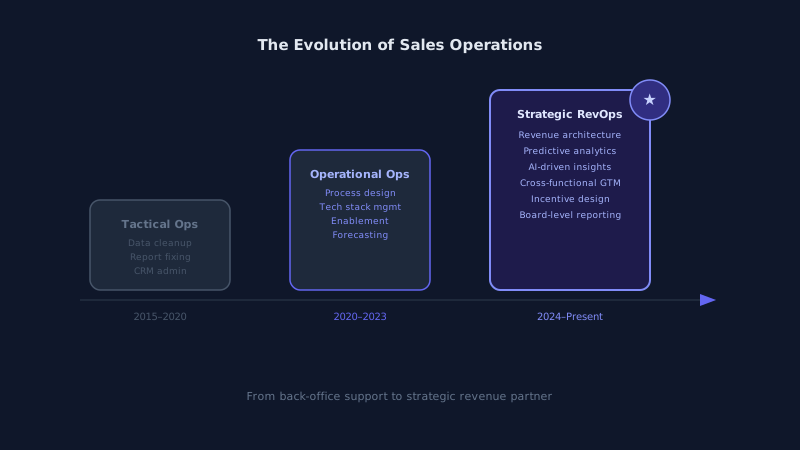
For years, the Sales Operations department was the "Back Office" of the sales organization—a team of spreadsheet wizards tasked with cleaning data, managing territories, and fixing the CRM when it inevitably broke. However, as the complexity of the B2B buyer's journey has skyrocketed, the role of Sales Ops has undergone a radical transformation. No longer just a functional support team, Sales Ops has evolved into a strategic partner—the engine room of the Revenue Machine.
In 2026, the best Sales Ops leaders aren't just reacting to problems; they are proactively designing the frameworks that drive growth. They have moved from "Fixing the past" to "Optimizing the future." This article explores the strategic evolution of Sales Ops and how organizations can leverage this function to build a competitive advantage through process discipline and data-driven insights.
The Shift from Tactical Cleanup to Strategic Design
The traditional "Tactical Sales Ops" model was defensive. It was about damage control and administrative maintenance. If a rep didn't know how to generate a quote, Sales Ops helped them. If a report was wrong, Sales Ops fixed it. While these tasks are still necessary, they no longer represent the core value of the function. Tactical Sales Ops is a cost center; Strategic Sales Ops is a revenue generator.
"Strategic Sales Ops" is offensive. It’s about revenue architecture. It involves looking at the entire customer lifecycle and asking: "Where is the friction? Why is our pipeline velocity slowing in the second half of the quarter? How can we reduce the 'Time to First Value' for our mid-market customers?" This shift requires a different set of skills—moving beyond Excel proficiency toward a deep understanding of organizational behavior, data science, and strategic design.
The Three Pillars of Strategic Sales Ops:
- The "Revenue Architecture": Designing the end-to-end stages, signals, and handoffs that define the sales motion.
- Predictive Intelligence: Moving beyond "What happened" to "What will happen" through advanced CRM analytics and AI.
- Enablement Alignment: Ensuring that every piece of sales collateral and training is directly linked to the actual needs of the rep in the field.
- Tech Stack Governance: Protecting the organization from tool bloat and context-switching fatigue.
Revenue Architecture: The Blueprint of Success
A strategic Sales Ops team acts as the architect of the revenue engine. They don't just "use" the CRM; they build the environment in which the sales team operates. This includes defining the exact "Exit Criteria" for every deal stage, ensuring that "Stage 3" means the same thing for every rep across every region. Without this standardization, the organization's data is essentially noise. Architecture is about creating a shared language for the entire company.
1. Designing the "Frictionless" Workflow
The best process is the one that is hardest to ignore. Strategic Sales Ops looks at the daily workflow of a sales rep and identifies "Digital dead weight"—unnecessary clicks, redundant data entry, and slow-loading dashboards. By consolidating the tech stack and automating the "Non-selling" tasks, Sales Ops gives the team back their most precious asset: time. Every second saved on admin is a second spent on the customer.
2. The Role of Governance and Guardrails
Processes only work if they are followed. Strategic Sales Ops implements "Process Guardrails"—system-enforced rules that prevent reps from skipping critical steps. For example, a deal cannot move to 'Proposal Sent' unless a 'Security Review' has been logged. These guardrails aren't meant to be bureaucratic; they are meant to protect the predictability of the forecast and the quality of the eventual implementation. They ensure that the organization's 'Best Practice' is its 'Only Practice.'
3. Data as a Strategic Asset, Not an Administrative Burden
Sales Ops must move the organization from "Collecting data" to "Using data." Every field in the CRM should have a purpose. If a piece of data isn't being used to drive a decision, a forecast, or a coaching conversation, it shouldn't be collected. By simplifying the data requirements, Sales Ops actually increases data quality, as reps are more likely to accurately complete three strategic fields than ten administrative ones. Data is the gasoline of the revenue engine; don't contaminate it with noise.
Predictive Intelligence: The Manager's Secret Weapon
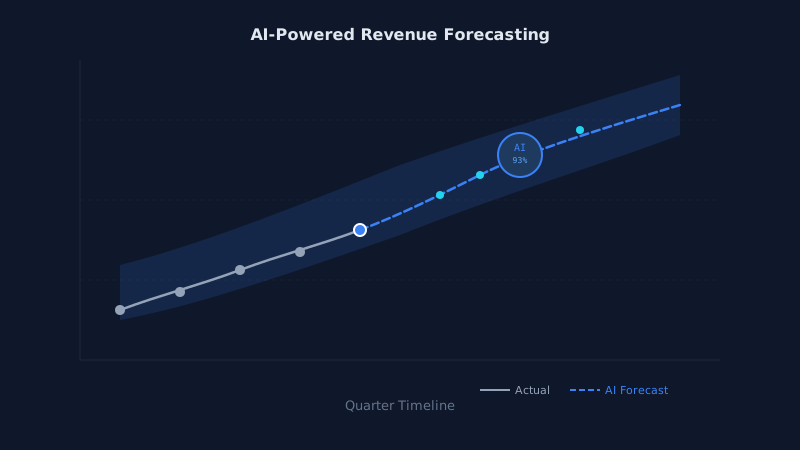
The future of Sales Ops is in predictive analytics. By analyzing historical win-loss data, Sales Ops can identify the "Leading Indicators" of success. They can tell a manager: "We’ve seen that when a prospect engages with our technical documentation in the first 14 days, the win rate increases by 40%. Let’s focus our reps on driving that specific behavior." This level of insight turns a sales manager from a "Closer-in-Chief" into a strategic data-driven coach. Ops provides the 'What,' and Management provides the 'How.'
Enablement as an Operation, Not an Event
Enablement—the training and content provided to sales teams—is often siloed away from Ops. Strategic organizations are bringing these functions together. Sales Ops identifies the performance gaps (e.g., "Our win rate against Competitor X is dropping"), and Enablement designs the specific solution (e.g., "Let’s build a new battlecard and run a 30-minute workshop"). This "Ops-Led Enablement" ensures that training is always focused on the issues that actually impact revenue. It moves training from 'Theory' to 'Tactics.'
Conclusion: The New Heart of the Organization
As we move deeper into 2026, the "Intuition-led" sales organization is becoming a relic of the past. The future belongs to the "Ops-led" organization—those that treat their revenue process as a product to be constantly refined, tested, and optimized. Sales Operations is no longer the back office; it is the strategic center of the revenue engine, and the leaders who embrace this shift will be the ones who define the future of B2B sales. The engine room is now the cockpit.